
Quarter One
The American Dream
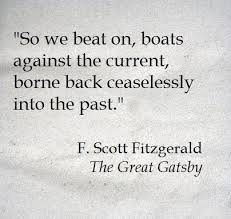
If I were to believe in the American Dream I would have to add that, throughout the years it has changed. Todays youth does not imagine the American Dream as a pretty Dutch colonial with a garden in the yard and a white picket fence, a perfect couple along with a golden retriever, arm in arm, awaiting the arrival of their two glowing children. Todays youth imagines things far greater, far more exotic, as everything has already happened and only the deeply astonishing or truly horrifying manage to surprise. I believe that the American Dream is simply the desire and determination for more. More of what depends. solely on the person. In The Great Gatsby, Gatsby wants more than the splendid grandeur with which he surrounds himself. He wants the love of the woman for whom he has done everything for: Daisy. Nick wanted more than the seemingly boring life he was leading. Maybe the American Dream is unreachable due to our very human nature. We will always want more.
rhetorical precis
This year we analyzed rhetorical strategies of a columnist of our choice. I chose columnist John Young. In nearly all five of the papers I wrote I noticed the consistency of the rhetorical strategies employed by Young. Young repeatedly mentioned his devotion to his church and this was meant to make the audience believe that he is a good man with strong opinions. He establishes ethos by appealing and connecting to an important aspect of his audience's lives: religion. Young also calls on his audience's sense of morality by repeatedly establishing what he believes is common human decency.

quarter one formal paper
Prompt: Compare and contrast the rhetorical strategies used in Jefferson's Declaration of Independence with the rhetorical startegies used in Stanton's Declaration of Sentiments and Resolutions. How does each author use rhetorical strategies to advance their argument regarding their vision of the American Dream?
timed writes
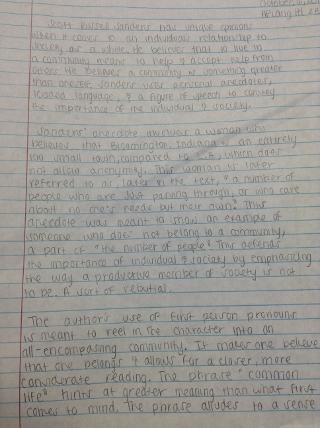
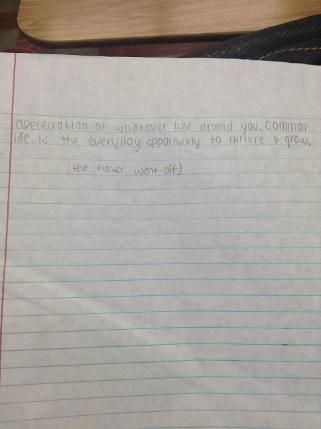
This was my favorite timed write due to the fact that the text was short and left a lot of room for interpretation.
quarter one reflection
This first quarter I have learned many things that I believe will help me in the future. among the most important was the lesson on Five-Paragraph essays. Though, by standard, they are formulaic and bland, we learned that by extending this template we can create a well-thought out essay with exciting and interesting insight that will earn us a 9 on the actual AP exam.

Quarter Two
Identity, Race and, Culture
Their Eyes Were Watching God by Zora Neale Hurston
Hurston is a brilliant writer. Among the many different things that struck me as different in this 20th century novel, the irony and perplexity in one character was a real insight into the confusion and cruelty of times of distress.
Mrs.Turner is described as a woman who shows obvious displeasure towards her own race since she worships the White race and anyone who appears closer to White than Black, as she believes she does. Mrs.Turner actively seeks out Janie to befriend and attempts to sway Janie into marrying her brother, as Mrs.Turner believes that Teacake is too black for Janie. Physically, Mrs.Turner is described as, "Her nose was slightly pointed and she was proud. Her thin lips were an ever delight to her eyes. Even her buttocks in bas-relief were a source of pride. To her way of thinking all these things set her aside from Negroes". She worships her Eurocentric features and Janie's "coffee and cream complexion", believing that they, as Blacks of a lighter complexion, " oughta class off" and "oughta lighten up de race".
The thing that interests me about her character is the symbolism behind Mrs.Turner. Mrs.Turner symbolizes a Benedict Arnold-type of betrayer against her own race especially since her supposed Eurocentric features don't add up to much, as is mentioned by Teacake whom, upon hearing Mrs.Turners' rantings about Black people, says "Her look lak uh white woman! Wid dat meriny skin and hair jus' as close tuh her head as ninety-nine is tuh uh hundred?" This shows desperation for acceptance into the superior, but, at least in her own eyes, always belonging to the inferior. Further evidence of this is seen when Hurston includes the description of Janie's attitude toward Mrs.Turner and Mrs.Turner's reaction, "Anyone who looked more white folk-ish than herself was better than she was in her criteria, therefore it was right that they should be cruel to her at times, just as she was cruel to those more negroid than herself in direct ratio to their negroness...Insensate cruelty to those you can whip, and groveling submission those you can't".

Rhetorical précis papers
This quarter, I analyzed 5 articles by columnist Austin Bay. In his writings, Bay is often critical and analytical on subjects he finds morally wrong and has extensive knowledge about. The most common rhetorical devices I noticed Bay use in all 5 of the columns were the appeals to rhetoric, mainly the establishment of ethos and logos.
Ethos is the establishment of credibility. Bay demonstrates mastery of this appeal with the informant-type relationship he maintains with his readers. It is evident in his writings that Bay preforms extensive research and this is noticed by his readers. Bay considers his audience by giving them only the facts and his audience, in turn, trusts him to give them only the facts. This bond is crucial as it makes the readers more receptive to his main ideas.
Logos can be demonstrated by the way an author may weave his reader's thoughts into taking the same direction as his. Bay demonstrates mastery of this on several occasions as he is a critically acclaimed columnist, which, the fact in itself is proof that his audience agrees with him. Bay includes many examples of weaving his thoughts logically into his writings so that the audience understands and sees a cause-and-effect relationship.

quarter 2 formal paper
Prompt: What defines a persons identity: their race and/or gender (physical or biological attributes) or their culture (environmental attributes)?

Quarter 2 formal paper self analysis

Quarter 2 reflection
This quarter seemed even more grueling than first quarter. But I guess that was to be expected in an AP course. This year, though I did not enjoy it very much, we learned of the proper way to formulate a research/ synthesis paper, and I found it a necessary skill to learn. The MLA format was also extremely handy to learn as it is expected in college. Given this Quarter's theme, there was also scintillating conversation in class. I very much enjoyed these discussion as they allowed me to hear different viewpoints and formulate my own. I am looking forward to more of theseconversations in the next Quarter, as the theme is Ethics.